
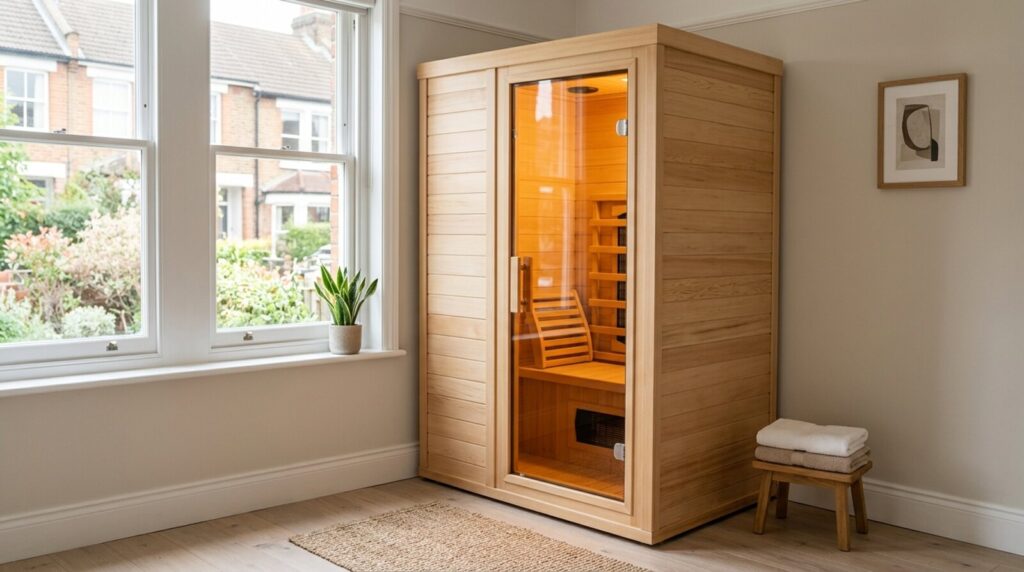
A 2-person infrared sauna sounds like the sensible hedge: more room, space for a partner, better resale. A 1-person cabin sounds like the practical pick: smaller, cheaper, quicker to heat. Both arguments are true, which is why so many buyers stall. The honest answer depends on four things you can measure before you spend a penny: the floor space you genuinely have, the power supply in that room, what each size costs to run, and whether anyone else in the house will realistically ever sit in it.
This guide works through each of those with current UK figures, from real cabin dimensions to the latest Ofgem unit rate, so you can settle the question in one sitting.
How big each cabin actually is
Manufacturers describe capacity loosely, so ignore the label and look at the external dimensions. Across current UK listings, the typical footprints are consistent:
- 1-person cabins: roughly 90 to 110cm wide, 90 to 125cm deep and 190 to 200cm tall. A representative compact model is 102cm wide by 103cm deep: just over one square metre.
- 2-person cabins: roughly 120 to 135cm wide, 105 to 125cm deep and 190 to 200cm tall. A common entry-level size is 120cm by 105cm, with premium models around 132cm by 122cm.
So the jump from one seat to two adds around 20 to 30cm of width and little else: roughly 1 to 1.2 square metres of floor area becomes roughly 1.3 to 1.6. That sounds trivial on paper, but in a small spare bedroom or a boxed-in garage corner, 30cm is often the difference between a cabin fitting comfortably and dominating the room.
Inside, the difference is felt on the bench. A 1-person bench at around 90 to 100cm lets you sit upright but not stretch your legs along it; a 2-person bench at 110 to 125cm lets a solo user sit sideways, raise their feet or change position mid-session, which counts for a lot over a 40-minute sit.
The space you really need: door swing, clearance and ceiling height
External dimensions are only the start; plan around the cabin too:
- Ventilation gap: manufacturers typically ask for around 5cm of clearance at the sides and rear, and around 30cm of free space above the roof so heat can dissipate.
- Ceiling height: with cabins standing 190 to 200cm tall plus that overhead gap, you want a ceiling of at least 2.2 to 2.3 metres. A standard 2.4m UK ceiling is fine; sloping loft eaves or low cellar joists often are not. Measure at the exact spot the cabin will stand.
- Door swing: almost all infrared cabins have a hinged glass door opening outwards, usually 50 to 60cm wide. Allow at least 60cm of clear space in front to open the door fully and step in.
- A level floor: panels and door alignment depend on it. A noticeably out-of-level garage slab will need packing before assembly.
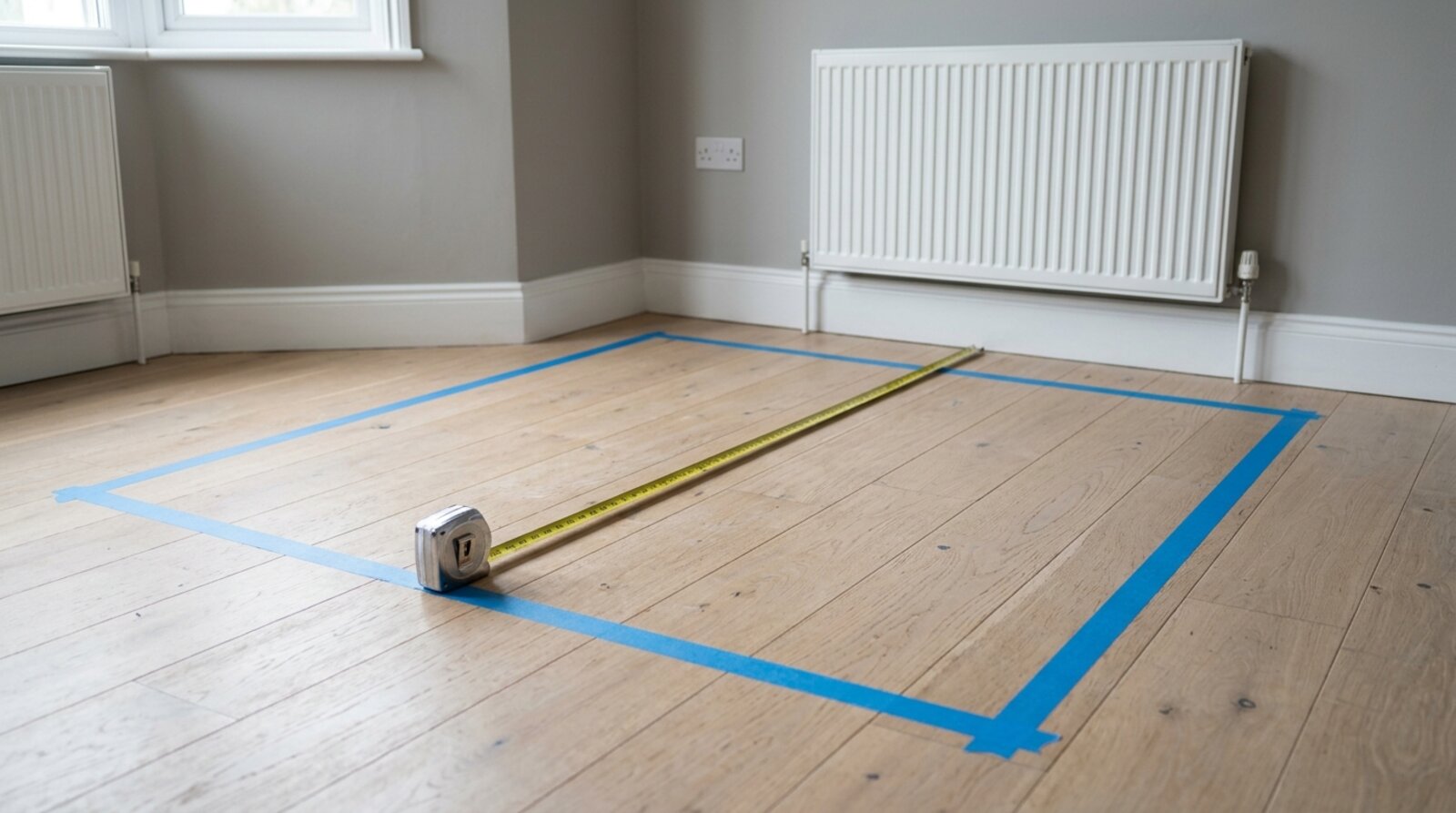
A practical test: mark the footprint on the floor with masking tape, door arc and rear gap included, and live with it for a week before ordering.
Power supply: when a 13A plug is enough and when you need an electrician
Most 1-person and 2-person infrared cabins sold in the UK are plug-and-play, running from a standard 13-amp three-pin socket. Current 1-person models draw around 1,300 to 1,800 watts; mainstream 2-person far-infrared cabins sit around 1,750 to 1,950 watts; even a premium 2-person full-spectrum cabin drawing 2,650 watts still ships with a 13A plug, since a 13A socket on a 230V supply can deliver close to 3,000 watts.
The caveats that actually matter:
- Use a dedicated socket, never an extension lead. A sauna drawing 1,600 to 2,650 watts continuously for an hour is exactly the sort of sustained load that overheats cheap extension reels and multi-way adaptors.
- Check what else is on that circuit. A garage or outbuilding fed by a single lightly rated spur may struggle with a sauna plus a freezer plus power tools.
- Larger cabins and add-ons can tip you over. Three-person and four-person cabins, and some full-spectrum models loaded with extra heaters or red-light add-ons, may need a dedicated hardwired circuit; ask the supplier for the total wattage in writing and have an electrician confirm before delivery day.
If a new dedicated circuit is required, that is notifiable work under Part P of the Building Regulations in England, so it must be carried out by an electrician registered with a competent person scheme or signed off through building control; the official guidance is Approved Document P on gov.uk. Budget a few hundred pounds for a straightforward new radial circuit, more if the consumer unit needs upgrading.
Running costs at current UK electricity prices
Under the Ofgem price cap for 1 April to 30 June 2026, the average electricity unit rate for a direct debit customer is 24.67 pence per kWh. The sums are easy and reassuringly small:
- 1-person cabin at 1,600W: the thermostat cycles the heaters once the cabin is up to temperature, so a 15-minute warm-up plus a 30 to 40 minute session typically uses 1 to 1.3kWh: roughly 25p to 32p per session.
- 2-person cabin at 1,750 to 1,950W: a comparable session uses around 1.3 to 1.7kWh: roughly 32p to 42p per session.
- Premium full-spectrum 2-person cabin at 2,650W: up to 2.65kWh per hour at full draw, so allow 50p to 65p per session.
At four sessions a week, the annual gap between a 1-person and a standard 2-person cabin is only around £15 to £25. Running cost alone should not drive this decision; the purchase price gap and the floor space matter far more.
The case for bigger, and the case for smaller
Buy the 2-person cabin if:
- A partner will plausibly use it, even occasionally; going too small is a common regret among buyers whose partner later wants to join in.
- You want stretching room: side-on sitting, raised legs, mobility work or simply not touching the walls.
- You are tall or broad. The extra 20 to 30cm of bench width is disproportionately valuable above six feet.
- You may sell or move within a few years: a cabin with room for two appeals to a wider pool of secondhand buyers than a strictly solo unit, and cabins disassemble back into panels for the move.
- The price gap is modest at your budget level: within the same range, the step from one seat to two is usually far smaller than the step between quality tiers.
Buy the 1-person cabin if:
- The honest answer is that only you will use it, and you sit rather than sprawl.
- Space is genuinely tight: a one square metre footprint fits a spare room corner or large landing that a 2-person cabin will not.
- You want the lowest purchase price, the quickest warm-up and the most direct heat: a smaller air volume comes up to temperature sooner, and the panels sit closer to your body.
- You need the lightest unit to get upstairs or through awkward access.
For a deeper look at cabin types, heater technologies and what separates the premium brands, the buying guides at The Shape House cover the wider decision beyond size alone.
Weight, floors, delivery and assembly
Cabin weight rises with size and build quality. Lighter entry-level 1-person units start around 100 to 150kg, while premium cabins are heavier: a current top-tier 1-person model weighs 193kg and its 2-person stablemate 204kg. Add an occupant or two and you have 300 to 400kg over little more than a square metre. Ground floors handle this without drama because the load spreads across the whole base. For an upstairs room in an older property, or any floor that already bounces underfoot, get a quick check from a builder or structural engineer, and position the cabin so its base spans several joists rather than sitting parallel between two.
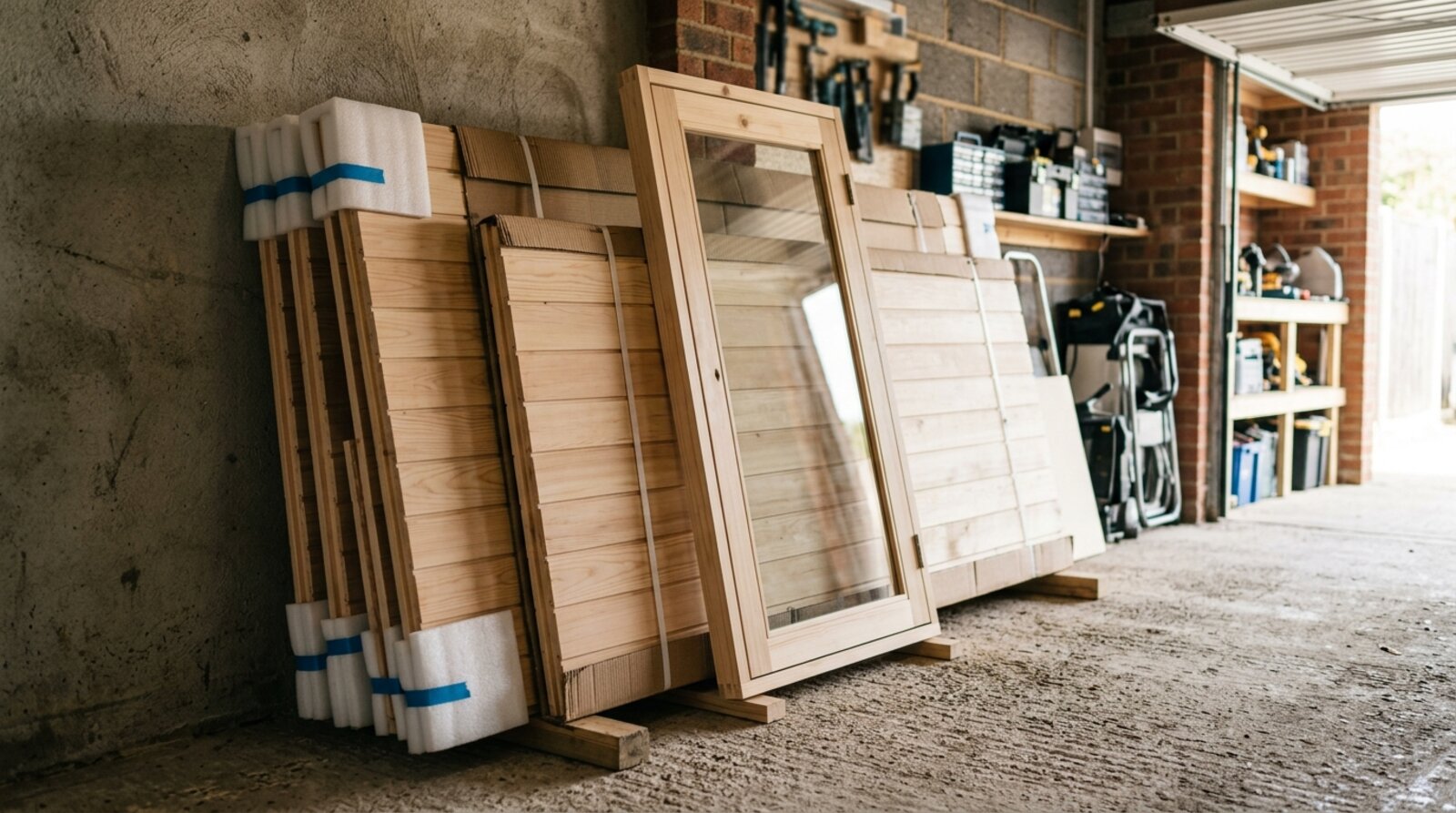
Delivery and assembly are easier than the weights suggest. Almost all home infrared cabins arrive flat-packed on a pallet as pre-built panels connected with buckle or clasp fittings; two people can assemble most 1-person and 2-person cabins in one to two hours without specialist tools. Before ordering, check the width of your narrowest doorway on the route in (the largest panel is usually the rear wall, around 100 to 130cm wide), any tight stair turns, and whether the courier offers room-of-choice delivery or kerbside only; a pallet of 200kg of panels left on the drive is a real two-person job.
If the cabin will only ever hold you, and space or budget is the constraint, the 1-person earns its keep. In every other case the 2-person is the better long-term buy: the footprint penalty is about 30cm of width, the running cost penalty is around 10p a session, and the gain is flexibility you cannot retrofit.
Frequently asked questions
Can a 2-person infrared sauna run off a normal UK plug socket?
Usually, yes. Mainstream 2-person far-infrared cabins draw around 1,750 to 1,950 watts and ship with a standard 13-amp plug, and even some 2,650-watt full-spectrum models stay within the roughly 3,000-watt limit of a 13A socket. Always plug directly into a wall socket, never an extension lead, and have an electrician check the circuit if it carries other heavy loads.
How much does an infrared sauna session cost in electricity?
At the Ofgem price cap unit rate of 24.67p per kWh for April to June 2026, a typical session including warm-up costs roughly 25p to 32p in a 1,600-watt 1-person cabin and about 32p to 42p in a standard 2-person cabin. High-powered full-spectrum cabins can reach 50p to 65p per session.
How much floor space do I need for a 1-person infrared sauna?
Plan for around 1.2 to 1.5 square metres in total: roughly one square metre for the cabin itself, plus about 5cm of ventilation gap at the sides and rear and at least 60cm of clear space in front for the outward-opening door, under a ceiling of about 2.2 metres or more.
Do I need an electrician to install a home infrared sauna?
Not for a plug-and-play model going into an existing, suitable socket. You do need one if the cabin requires a new dedicated circuit, which is notifiable work under Part P of the Building Regulations in England and must be done by a registered electrician or signed off via building control.
Is a 2-person sauna worth it for one person?
Often, yes. The extra bench width lets a solo user sit sideways, stretch their legs and move during a session, and a 2-person cabin is likely to interest a wider pool of buyers if you ever sell it on. The trade-offs are about 30cm more width, a slightly longer warm-up and a marginally higher running cost.
Related guides
- Heat Pump vs Gas Boiler in 2026: Real Running Costs for UK Homes
- Underfloor Heating vs Radiators: UK Cost, Comfort and Retrofit Guide
- Home Sauna Cost UK 2026: Install Price and Running Cost per Session
- Porcelain vs Ceramic Tiles for Bathrooms and Wet Rooms: Cost, Durability and Where Each One Actually Belongs
- How to Stop Bathroom Condensation and Damp for Good: Extractor Fans vs MVHR Compared for UK Homes
- Microcement vs Tiles for a Wet Room: Real Costs, Cracking Risk and Which Lasts Longer in the UK
- Air Source vs Ground Source Heat Pumps: Which Suits a UK Home?
- How to Cut Your Heating Bills: Proven Steps for UK Homes
- Home Wellness News: June 2026
- Carbon vs Ceramic Infrared Sauna Heaters: What’s the Difference?
- How Much Does It Cost to Run an Infrared Sauna at Home? (UK Energy Costs)
- What to Look for When Buying an Infrared Sauna: 12 Questions to Ask First
- Are Infrared Saunas Worth It? An Honest Look at the Cost vs Benefits
- Sauna and Home Wellness News: Mid-June 2026
- Sauna Blanket vs Infrared Sauna: Which Is Actually Worth It?
- Red Light Therapy vs Infrared Sauna: Benefits and Key Differences
- Far Infrared vs Near Infrared Sauna: Which Wavelength Do You Need?
- Infrared Sauna vs Steam Room: Heat, Benefits and Home Setup Compared
- Home Wellness News: Late June 2026
- Infrared Sauna Benefits: What the Evidence Actually Shows
- Infrared Sauna for Weight Loss: Does It Really Burn Fat?
- Infrared Sauna for Skin: Collagen, Glow and Anti-Ageing Explained
- Home Wellness News: Early July 2026
- Infrared Sauna Detox: What Your Sweat Can and Can’t Remove
- Infrared Sauna Before or After a Workout? The Best Timing for Recovery
- What to Wear in an Infrared Sauna (and What to Avoid)
- Home Wellness News: Mid-July 2026
- Infrared Sauna for Beginners: A First-Month Session Plan
- Infrared Sauna Temperature and Session Length: A UK Guide
- Infrared Sauna Blanket UK: The Complete Buyer’s Guide
- Do Sauna Blankets Actually Work? What the Evidence Shows
- How to Use a Sauna Blanket: Setup, Timing and Cleaning
- Are Infrared Sauna Blankets Safe? EMF, Burns and Skin Contact
- Home Wellness News: Mid-July 2026
- Sauna Blanket vs Sauna Dome vs Tent: Which Portable Option Wins?
- Contrast Therapy at Home: How to Combine Sauna and Cold Plunge
- Cold Plunge Benefits: What Ice Baths Do for Recovery and Mood
- Sauna Before or After Cold Plunge? The Right Order
- Ice Bath Temperature and Time: A Beginner’s Guide
- Best Cold Plunge Tubs for a Home Setup: UK Buyer’s Guide (2026)
- Home Wellness Room Ideas: Sauna, Cold Plunge and Recovery Space
- Where to Put an Infrared Sauna in Your House: 7 Best Locations
- Infrared Sauna Installation Requirements UK: Space and Electrics
- Can You Put an Infrared Sauna Outside? Garden Sauna Rules