
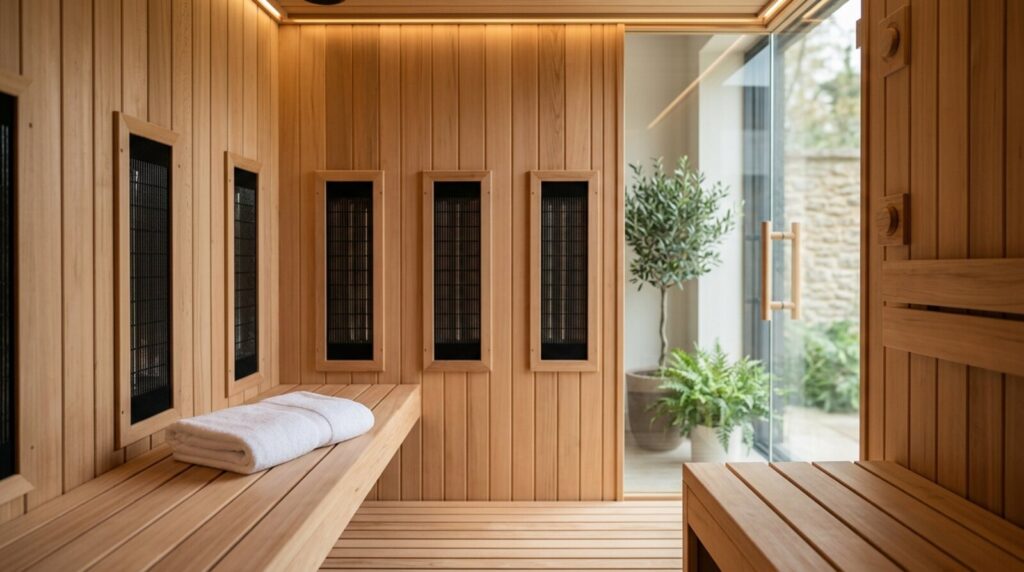
Two cabins can look almost identical in a showroom yet feel completely different once you sit inside. The reason is usually the heaters bolted behind the wood. Most home infrared saunas use one of two technologies: large carbon-fibre panels or slimmer ceramic rods and tubes. They both produce infrared heat, but they do it in different ways, and that affects how the warmth feels, how evenly the cabin heats, how much electricity you use and how long the unit lasts.
This guide explains how infrared heaters actually work, then compares carbon and ceramic across the things that matter to a UK buyer. We have kept the health side honest: infrared saunas are pleasant and there is some research interest in them, but the evidence is limited, so treat any bold medical promise with caution.
How infrared sauna heaters work
A traditional Finnish sauna heats the air, often to 80 to 100 degrees Celsius, and that hot air warms you. An infrared cabin works differently. The heaters emit infrared radiation that travels across the cabin and is absorbed directly by your skin, so you feel warm at a much lower air temperature, typically around 45 to 65 degrees Celsius. That lower air temperature is why many people find infrared more comfortable to sit in for longer.
Infrared sits just beyond visible red light on the spectrum and is split into three bands by wavelength. Near infrared has the shortest wavelengths and is absorbed closest to the skin surface. Mid infrared sits in the middle. Far infrared has the longest wavelengths, generally taken to run from roughly 5.6 microns upwards, and is the band most home cabins are built around. When a brand markets a cabin as a “far infrared sauna”, it means the heaters are tuned to put most of their output into that longer-wave range.
This matters for the carbon versus ceramic question, because the two heater types naturally emit at slightly different wavelengths and run at different surface temperatures.
Carbon-fibre panel heaters
Carbon heaters are wide, flat panels, sometimes the size of a large book or bigger, with a sheet of carbon-fibre material that warms up when current passes through it. Because the heat is spread across a large surface, the panel runs at a relatively low surface temperature and emits long-wave far infrared, commonly in the region of 8 to 10 microns.
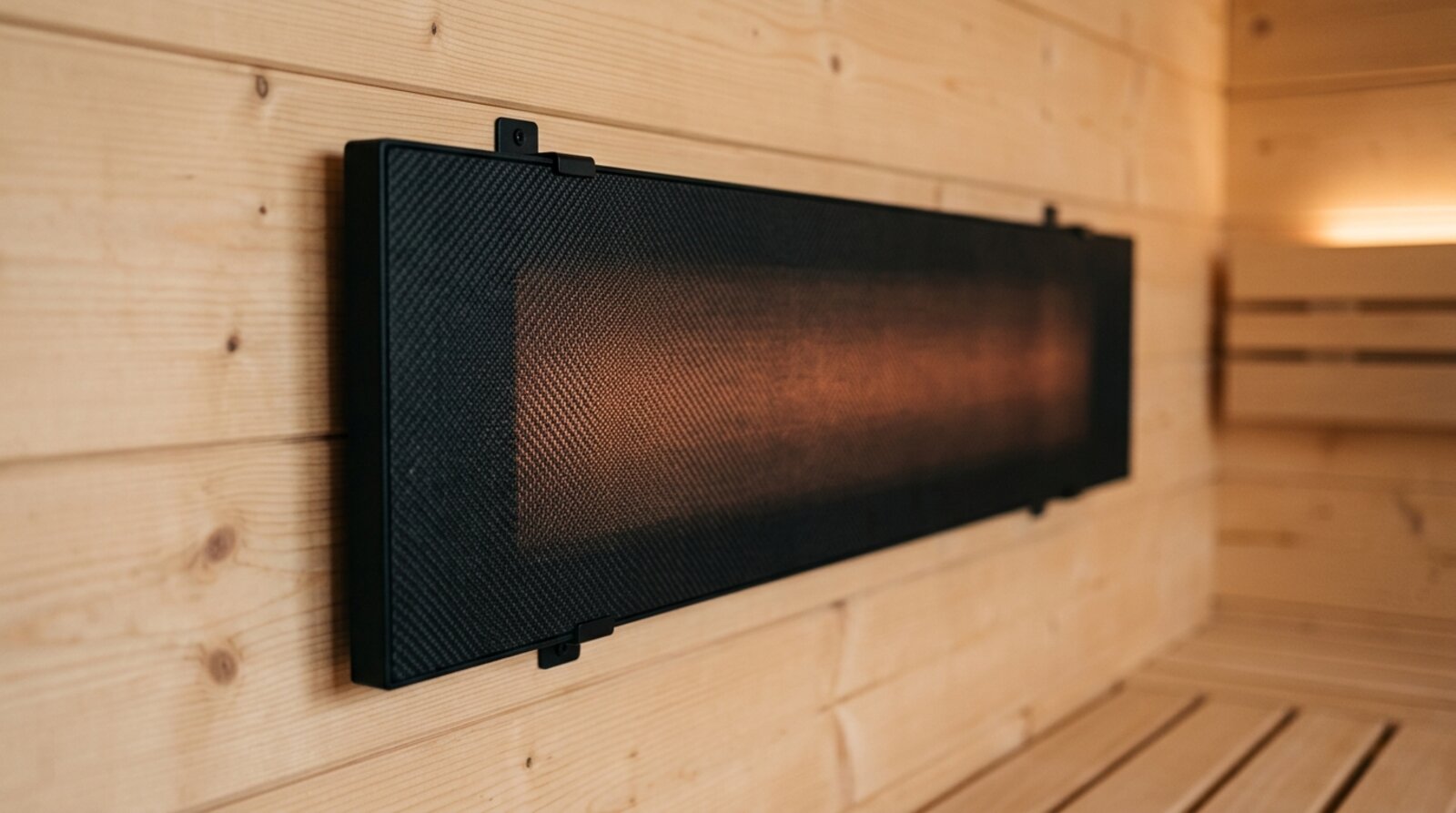
How the heat feels. Carbon gives a gentle, even, radiant warmth that feels like sunshine rather than a hot bar near your skin. The large emitting area means the infrared reaches more of your body at once, including your back, which suits people who want a softer, all-over session.
Even heating. Because manufacturers fit several broad panels around the cabin, behind the back, beside the legs, below the bench, the warmth is distributed across a wider area with fewer cold spots. This is one of carbon’s main selling points.
Heat-up and energy. Carbon panels reach a comfortable operating point quickly, often within 10 to 15 minutes, and a typical one or two person infrared cabin draws somewhere around 1.5 to 2.5 kW. They are efficient because almost all the energy goes into low-temperature radiant heat rather than heating air.
Durability. With no glowing element to burn out, quality carbon panels tend to have a long service life and degrade gradually rather than failing suddenly.
Low-EMF point. Carbon panels are generally easier to engineer for low electromagnetic field (EMF) emissions, and several brands sell panels measured at well under 1 milligauss close to the surface. A commonly cited precautionary threshold for continuous exposure is around 3 milligauss, so if EMF concerns you, ask the seller for measured figures at seat distance, not just a marketing label.
Ceramic rod and tube heaters
Ceramic heaters use rods or tubes coated in ceramic material. They concentrate the heat into a smaller area, so they run hotter at the surface and emit shorter far-infrared and some mid-infrared wavelengths, often quoted in the region of 4 to 6 microns.
How the heat feels. Ceramic produces a more intense, focused heat. Sit close to a ceramic emitter and you feel it strongly; move away and the effect drops off faster than with a broad carbon panel. Some people prefer that punchier, more obviously “hot” sensation, especially if they like to feel the heat building quickly.
Even heating. Because the emitters are smaller and hotter, the warmth can be less uniform, with hotter zones near the rods and cooler areas in between. Good cabin design and emitter placement reduce this, but evenness is generally where ceramic trails carbon.
Heat-up and energy. Ceramic elements get hot fast and can raise the cabin’s air temperature quickly. Power draw for a home cabin sits in a broadly similar 1.5 to 3 kW band, so running costs are comparable rather than dramatically different.
Durability. Ceramic emitters are hard-wearing but run at higher temperatures, and individual rods can eventually fail and need replacing, which is worth checking against the warranty.
Emissivity. One honest point in ceramic’s favour: ceramic is a strong infrared emitter, so it can put out a lot of radiant energy for its size. The trade-off is the hotter, more localised surface and the shorter wavelength.
Carbon vs ceramic: the head-to-head
Pulling the two together:
- Wavelength and depth of feel: carbon leans to longer-wave far infrared (around 8 to 10 microns) for a soft, deep-feeling warmth; ceramic leans shorter (around 4 to 6 microns) for a more surface-intense heat.
- Surface temperature and comfort: carbon panels stay cooler to the touch and feel gentler; ceramic rods run hotter and feel more direct.
- Even heating: carbon usually heats the cabin more evenly thanks to large panels; ceramic can be patchier unless well placed.
- Heat-up time and energy: both are far more efficient than a traditional sauna; ceramic can feel hot a touch faster, carbon is very even once warm. Power draw is broadly similar.
- Durability and lifespan: carbon has no element to burn out and ages gently; ceramic is sturdy but individual emitters can fail over time.
- Price tier: entry-level cabins are often ceramic, mid and premium cabins are usually carbon or a hybrid; full-spectrum cabins that add near and mid infrared sit at the top.
- Low-EMF builds: carbon panels are generally easier to make low-EMF, which is why many wellness-focused brands favour them.
Many newer cabins combine both, using carbon for broad, even far-infrared coverage and adding ceramic or near-infrared emitters in a “full spectrum” layout. If a cabin is described as full spectrum, it is reaching across more of the infrared range, not just the far band.
Far infrared vs near infrared: an honest note
You will see near infrared promoted heavily, often alongside claims about skin and muscle recovery. It is true that near infrared is absorbed closer to the skin surface while far infrared, the longer wavelength, is the band most home cabins are designed around. What deserves a sober eye is the health messaging. A summary of published evidence in Canadian Family Physician found only limited, moderate evidence for far-infrared sauna therapy on some cardiovascular risk factors, and consistently found no benefit for cholesterol. You can read that review summary on PubMed. Most people buy an infrared sauna because it is relaxing and comfortable, which is a perfectly good reason on its own. Treat specific medical promises with scepticism, and if you have a heart condition, are pregnant or take medication, check with your GP before regular use.
Running costs and energy use in the UK
Infrared cabins are cheap to run by sauna standards because they heat you rather than a large volume of air. A typical home unit draws around 1.5 to 2.5 kW. Using the Ofgem price cap unit rate for July to September 2026 of about 26 pence per kWh, a 30 minute session on a 2 kW cabin works out at roughly 26 pence of electricity. That is a useful rule of thumb, though your actual cost depends on your tariff, region and how long the heaters run at full power. You can check the current cap on the Ofgem website. Whether you choose carbon or ceramic makes little difference to that bill, because both are low-temperature radiant systems in a similar power band.
Which should you choose?
There is no single winner, only a better fit for how you want to use the cabin.
- Choose carbon if you want a gentle, even, all-over warmth you can sit in comfortably for longer, you care about low EMF, and you are buying for relaxation and regular use. This suits most home buyers.
- Choose ceramic if you like a more intense, fast-building heat, you are happy to position yourself near the emitters, and you are working to a tighter budget at the entry level.
- Choose full spectrum (carbon plus near and mid infrared) if you want the widest range of wavelengths in one cabin and the budget to match, and you understand you are paying for breadth of output rather than a guaranteed health outcome.
Whichever you lean towards, judge the specific cabin, not just the heater type. Ask for the operating wavelength range, measured EMF at seat distance, total power draw, warranty terms on the heaters, and the timber and build quality. A well-designed ceramic cabin can beat a poorly designed carbon one. If you would like help matching a model to your space and budget, browse the ranges and buying guidance over at The Shape House.
Frequently asked questions
Is carbon or ceramic better for a home infrared sauna?
For most home buyers, carbon is the easier choice: it gives gentle, even far-infrared warmth, runs at a lower surface temperature and is generally easier to build with low EMF. Ceramic suits people who prefer a more intense, faster-feeling heat or who are buying at the entry-level price point.
Are infrared saunas expensive to run in the UK?
No, they are relatively cheap. A typical home cabin draws around 1.5 to 2.5 kW, so a 30 minute session costs roughly 25 to 35 pence at current price-cap electricity rates. The heater type, carbon or ceramic, has little effect on this because both are efficient low-temperature radiant systems.
What does low EMF actually mean and does it matter?
EMF stands for electromagnetic field, produced by any electrical appliance. Some buyers want it kept low as a precaution. Quality carbon panels can be measured at well under 1 milligauss near the surface, against a commonly cited precautionary threshold of around 3 milligauss. Ask the seller for measured figures taken at where you actually sit, not just a label.
Is far infrared safer or better than near infrared?
Neither is unsafe at the levels used in home cabins. They simply differ: near infrared is absorbed closer to the skin, while far infrared, the longer wavelength, is what most home cabins are built around. Full-spectrum units combine both. The published health evidence is limited, so choose based on comfort and build quality rather than medical claims.
How long does an infrared sauna take to heat up?
Far less time than a traditional sauna. Carbon panels reach a comfortable operating point in roughly 10 to 15 minutes, and ceramic emitters can feel hot even faster. Because you sit in cooler air than a Finnish sauna, you do not need to wait for the air itself to reach a high temperature.
Do carbon or ceramic heaters last longer?
Carbon panels have no glowing element to burn out and tend to age gradually, which often gives them a long service life. Ceramic emitters are sturdy but run hotter, and individual rods can eventually fail and need replacing. Check the heater warranty carefully whichever type you choose.
Related guides
- Heat Pump vs Gas Boiler in 2026: Real Running Costs for UK Homes
- Underfloor Heating vs Radiators: UK Cost, Comfort and Retrofit Guide
- Home Sauna Cost UK 2026: Install Price and Running Cost per Session
- Porcelain vs Ceramic Tiles for Bathrooms and Wet Rooms: Cost, Durability and Where Each One Actually Belongs
- How to Stop Bathroom Condensation and Damp for Good: Extractor Fans vs MVHR Compared for UK Homes
- Microcement vs Tiles for a Wet Room: Real Costs, Cracking Risk and Which Lasts Longer in the UK
- Air Source vs Ground Source Heat Pumps: Which Suits a UK Home?
- How to Cut Your Heating Bills: Proven Steps for UK Homes
- Home Wellness News: June 2026
- 1-Person vs 2-Person Infrared Sauna: Which Size Is Right for You?
- How Much Does It Cost to Run an Infrared Sauna at Home? (UK Energy Costs)
- What to Look for When Buying an Infrared Sauna: 12 Questions to Ask First
- Are Infrared Saunas Worth It? An Honest Look at the Cost vs Benefits
- Sauna and Home Wellness News: Mid-June 2026
- Sauna Blanket vs Infrared Sauna: Which Is Actually Worth It?
- Red Light Therapy vs Infrared Sauna: Benefits and Key Differences
- Far Infrared vs Near Infrared Sauna: Which Wavelength Do You Need?
- Infrared Sauna vs Steam Room: Heat, Benefits and Home Setup Compared
- Home Wellness News: Late June 2026
- Infrared Sauna Benefits: What the Evidence Actually Shows
- Infrared Sauna for Weight Loss: Does It Really Burn Fat?
- Infrared Sauna for Skin: Collagen, Glow and Anti-Ageing Explained
- Home Wellness News: Early July 2026
- Infrared Sauna Detox: What Your Sweat Can and Can’t Remove
- Infrared Sauna Before or After a Workout? The Best Timing for Recovery
- What to Wear in an Infrared Sauna (and What to Avoid)
- Home Wellness News: Mid-July 2026
- Infrared Sauna for Beginners: A First-Month Session Plan
- Infrared Sauna Temperature and Session Length: A UK Guide
- Infrared Sauna Blanket UK: The Complete Buyer’s Guide
- Do Sauna Blankets Actually Work? What the Evidence Shows
- How to Use a Sauna Blanket: Setup, Timing and Cleaning
- Are Infrared Sauna Blankets Safe? EMF, Burns and Skin Contact
- Home Wellness News: Mid-July 2026
- Sauna Blanket vs Sauna Dome vs Tent: Which Portable Option Wins?
- Contrast Therapy at Home: How to Combine Sauna and Cold Plunge
- Cold Plunge Benefits: What Ice Baths Do for Recovery and Mood
- Sauna Before or After Cold Plunge? The Right Order
- Ice Bath Temperature and Time: A Beginner’s Guide
- Best Cold Plunge Tubs for a Home Setup: UK Buyer’s Guide (2026)
- Home Wellness Room Ideas: Sauna, Cold Plunge and Recovery Space
- Where to Put an Infrared Sauna in Your House: 7 Best Locations
- Infrared Sauna Installation Requirements UK: Space and Electrics
- Can You Put an Infrared Sauna Outside? Garden Sauna Rules